
Chimney cleaning, inspection and repair for homes across Sanford.
The Seminole County seat on the south shore of Lake Monroe, where about one home in seven went up before 1960 and the typical house dates from 1994.
- Send a requestThe form never closes
- A person rings backTo fix a day with you
- Based in SanfordSeminole County, Florida
Everything we look after, from rooftop to hearth.
 Reserve a sweep
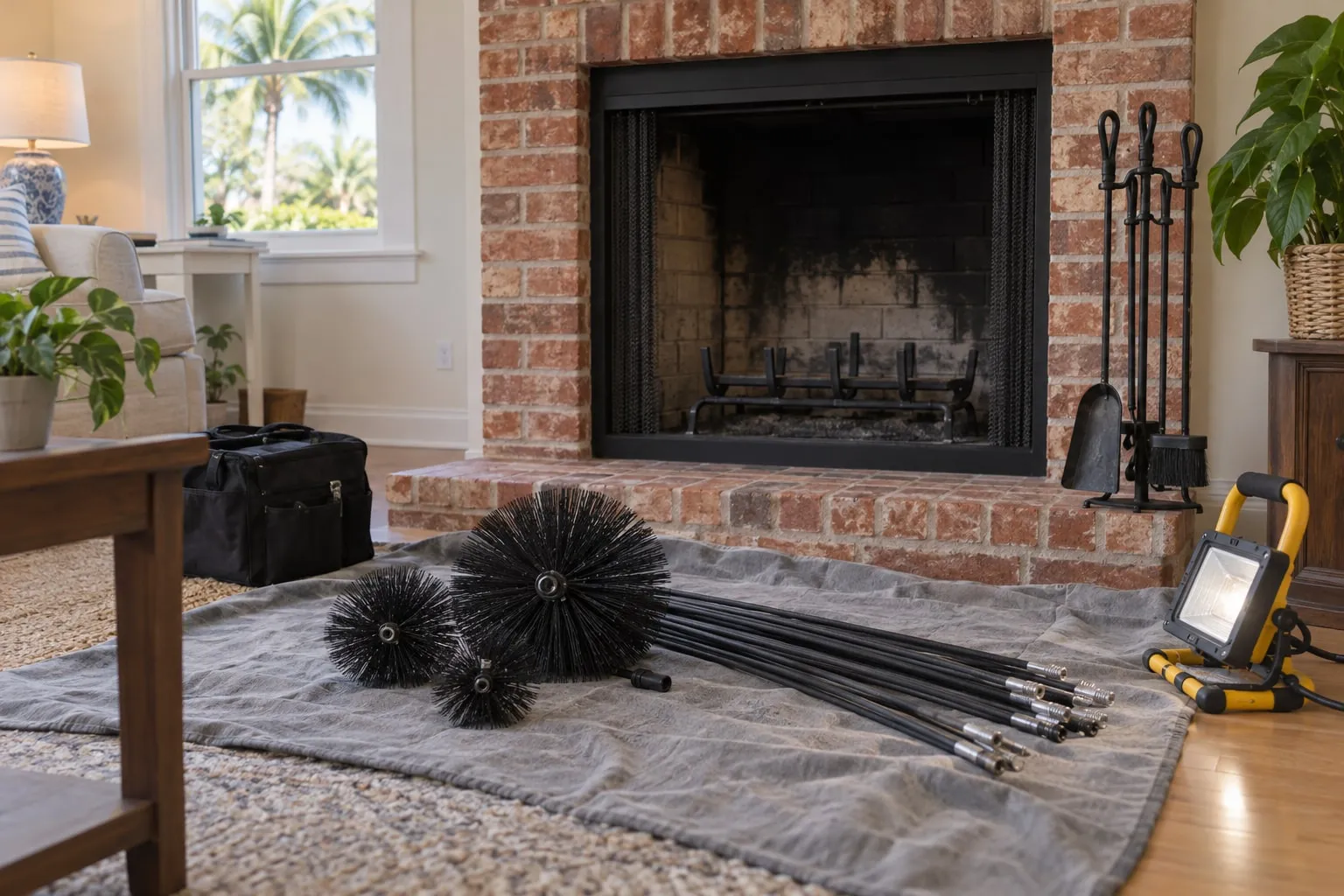
Brushes take soot and creosote off the flue walls, and the shelf above the damper and the firebox floor are cleared as well. Even a fireplace lit a few times a year gathers some deposit.
- Damper-to-cap brush pass
- Smoke shelf and floor emptied
- A plain-spoken report
 Reserve an inspection
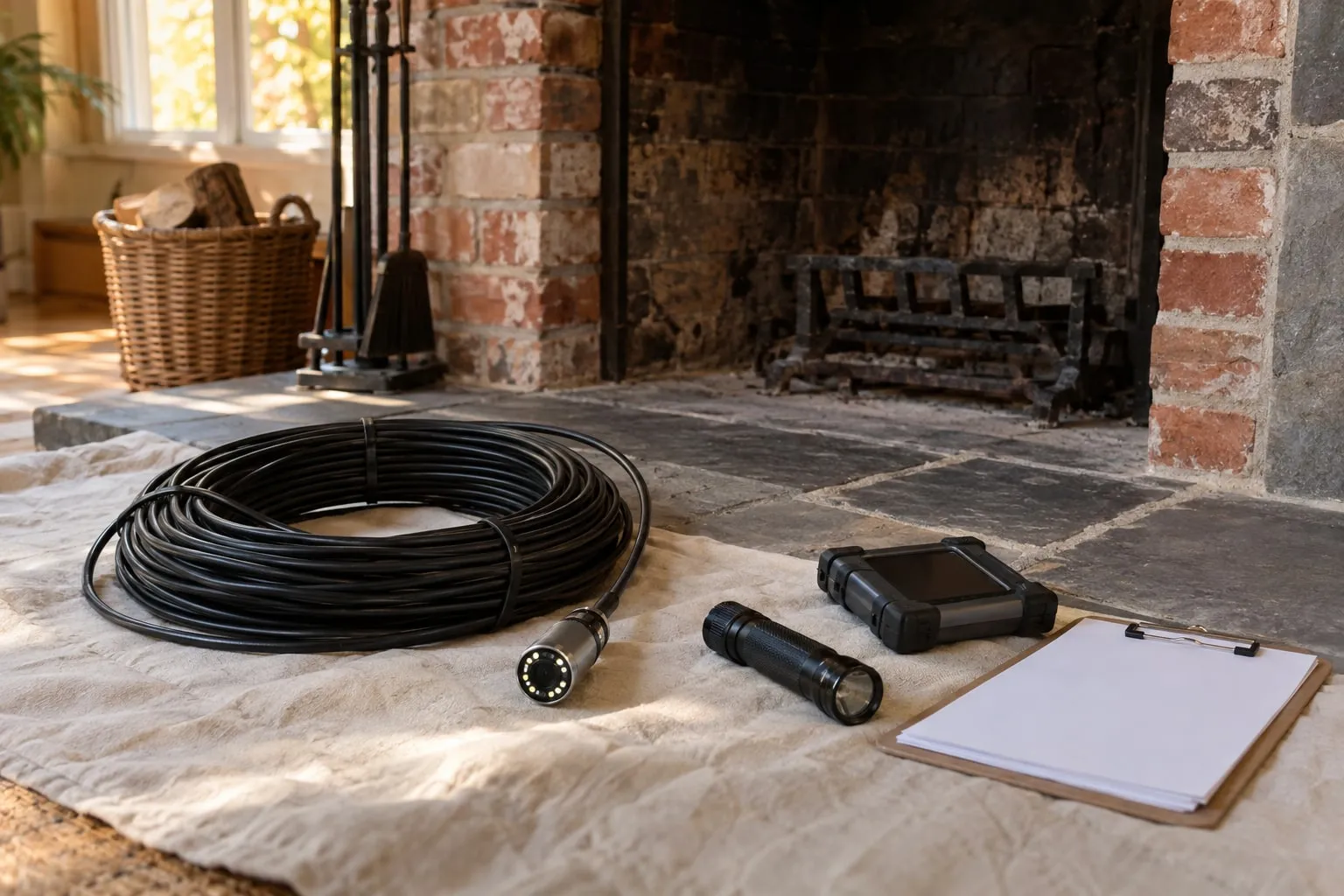
A careful look at all six parts, cap to firebox. Worth doing every year, after a storm or chimney fire, and when a house changes owners; NFPA 211 calls for a deeper Level 2 when a house is sold.
- Cap, crown and flashing
- Flue examined end to end
- Each fault in plain words
 Reserve a repair
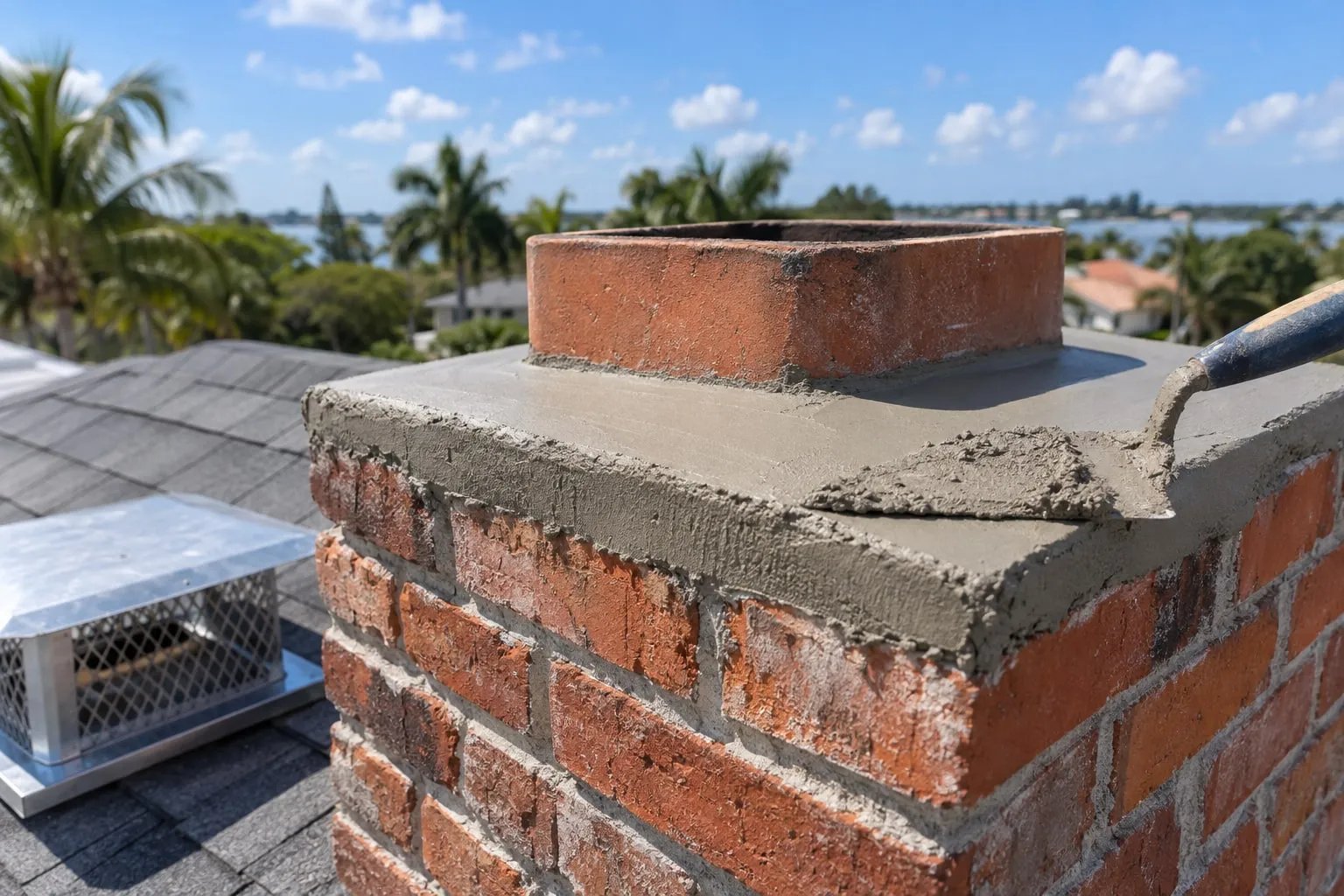
Crumbling mortar, split firebrick, loose caps, cracked crowns and tired flashing. A fault dealt with while it is small costs less than the same one after another rainy summer.
- Crowns sealed or recast
- New caps and mesh
- Flashing resealed, joints repointed
 Reserve a cleaning
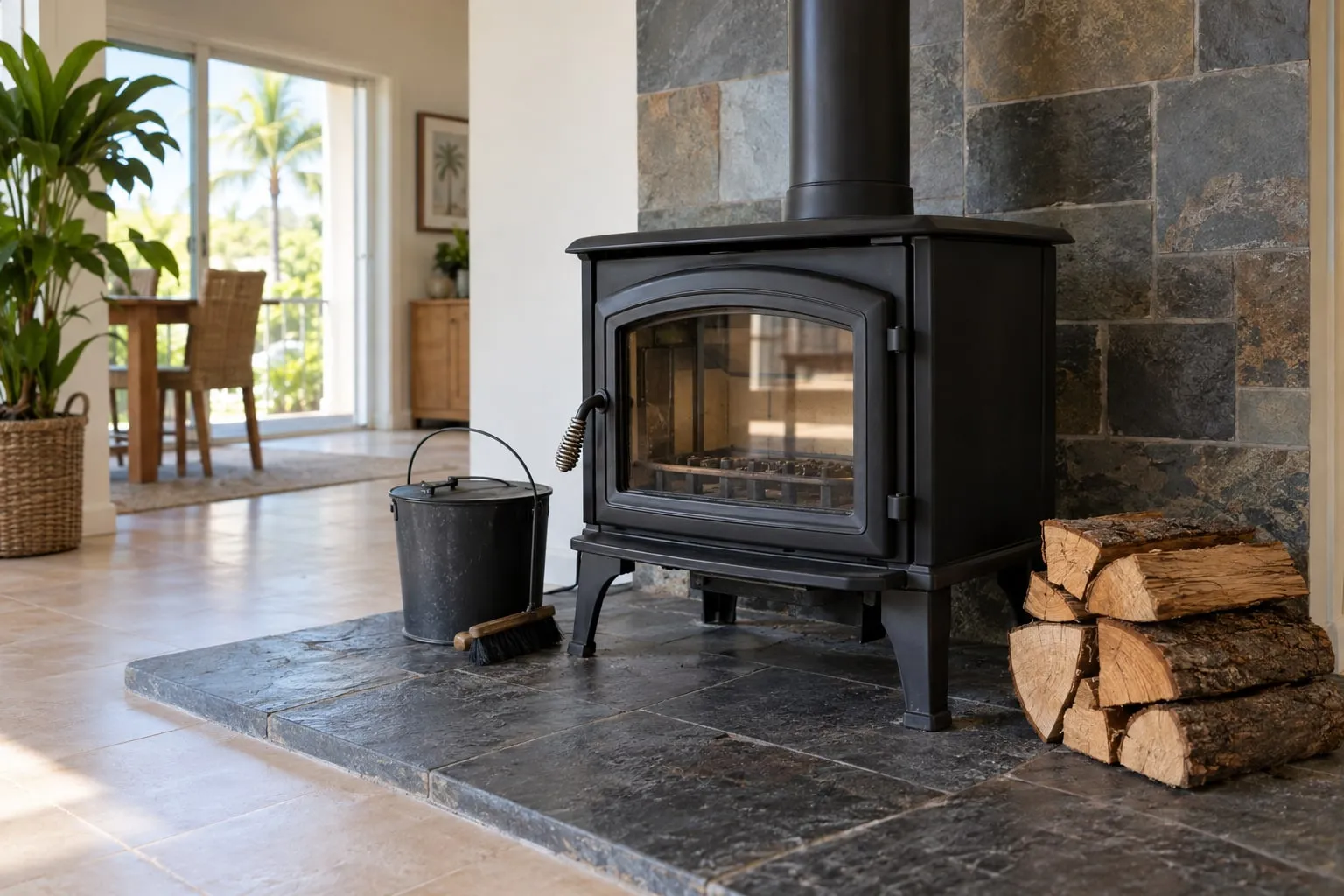
For a hearth or stove that sees only an occasional fire, as is likely where freezing nights are rare. Ash and soot come out, the stovepipe is brushed and the damper is run through its range.
- Ash and soot lifted out
- Stove, insert and pipe brushed
- Damper run through its range
Six parts, cap to firebox, and what a Central Florida year does to each.
What we look for at each part, and how wet-season downpours, tropical storms and lightning bear on it around Sanford.
The cap, above the roof.
The first part the weather reaches: summer downpours, hurricane gusts and nearby lightning. Its lid turns rain and birds back, and its mesh holds sparks inside the flue.
Look fordents left by a storm; mesh that has worked loose; rust on the lid or its fasteners.
The crown, under the cap.
The crown sheds water, and the Florida Building Code asks for a slope, a drip edge and a caulked break at the liner. Sanford's airport station normally collects about 28 inches from June to September, so a hairline crack is soaked again and again.
Look forfine cracks; chipped corners; a slab lifting from the tile beneath; no drip edge.
The flashing, where roof meets masonry.
A metal collar closes the seam between chimney and roof. Wind-driven rain goes looking for a raised edge or a dried-out bead of sealant, and the first clue indoors tends to be a brown stain on the ceiling.
Look foran edge that stands off the roof; cracked sealant; rust streaks; a stain on a ceiling or attic wall.
The flue liner, behind the brick.
Within the masonry, the liner leads smoke away from the living space, and Florida's code requires masonry chimneys to have one. With a median build year of 1994 in Sanford, plenty of flues have worked for three decades or more.
Look forseams rusted through; cracked or shifted tiles; a liner of the wrong type for its appliance.
The smoke chamber and damper.
Just above the damper a shelf of masonry catches soot and creosote first. Light use fills it slowly, yet it is never empty, and a damper that will not seal leaves the flue open to everything that falls down it.
Look fora glossy or tar-like coat; a damper that will not close all the way; a shelf that flakes or leans.
The firebox, at the fireplace.
Every fire bakes the firebox walls: the firebrick crazes and the mortar between the bricks opens. Filling a hairline gap is inexpensive; once heat has reached the framing behind it, the job is not.
Look forgaps opening in the mortar; firebrick that sheds flakes or cracks; a hearth that rocks underfoot.
How the weather wears on a Sanford chimney.
Three kinds of Central Florida weather, and why a small fault is cheaper to fix before the next one.
01 / 03
57. Percent of the year's rain that falls from June to September
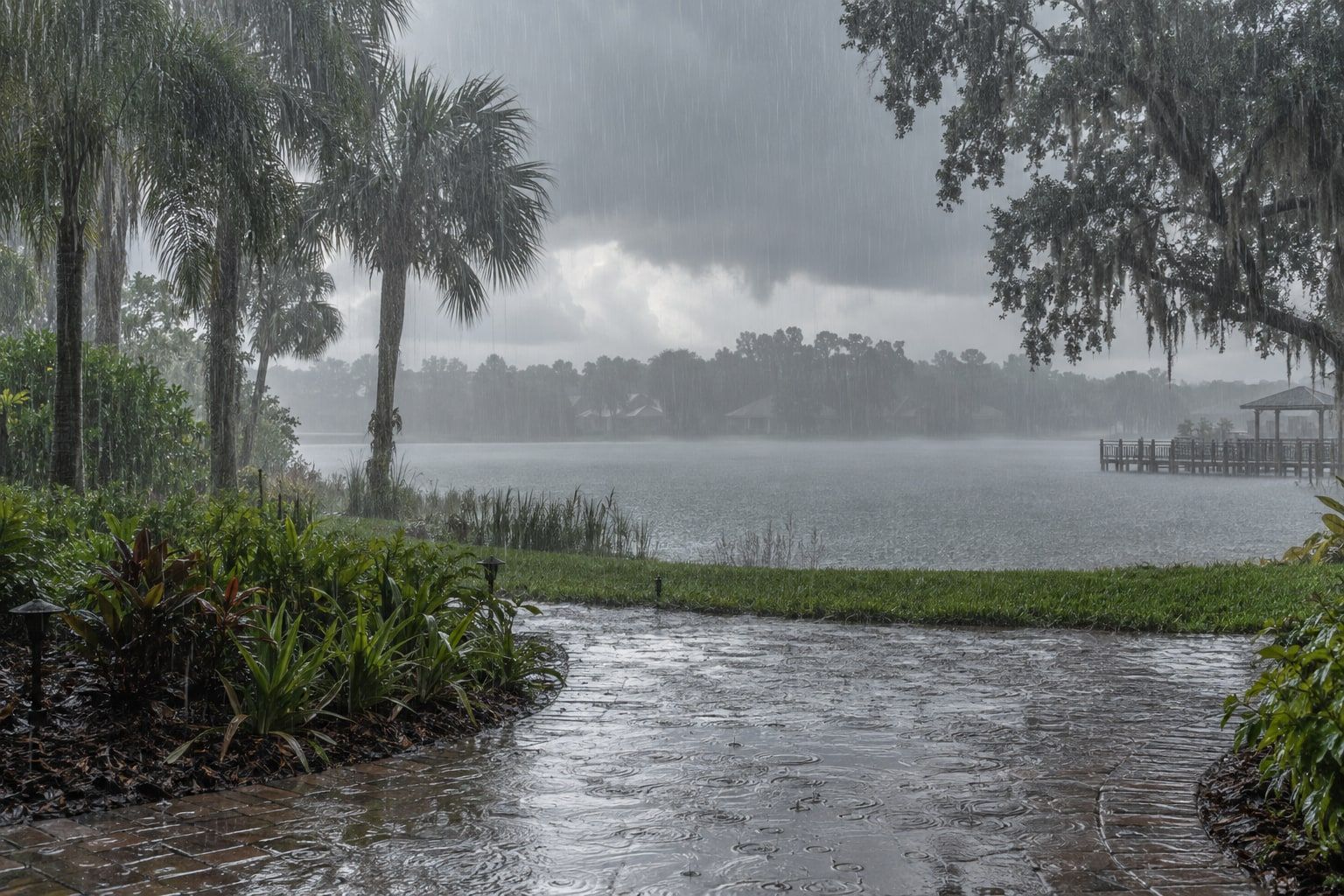
Sanford's rainy season is lopsided. NOAA's 1991 to 2020 normals for the Orlando Sanford Airport station put the year at 49.63 inches, with 8.19 in June alone and 28.49 between June and September, which is 57 percent of the total. The Florida energy code places Seminole County in climate zone 2A, moist. Hurricane Ian dropped 16.10 inches at the airport on September 27 to 29, 2022. Water finds a hairline crack in a crown or a lifted edge of flashing and soaks the masonry under it, so a small gap is worth closing before the wet season starts.
Source: NOAA normals of 1991 to 2020 and daily summaries for station USW00012854 (Orlando Sanford Airport); Florida Building Code, Energy Conservation, table R301.1
02 / 03
84. Peak gust, in mph, at the Sanford airport in Hurricane Milton
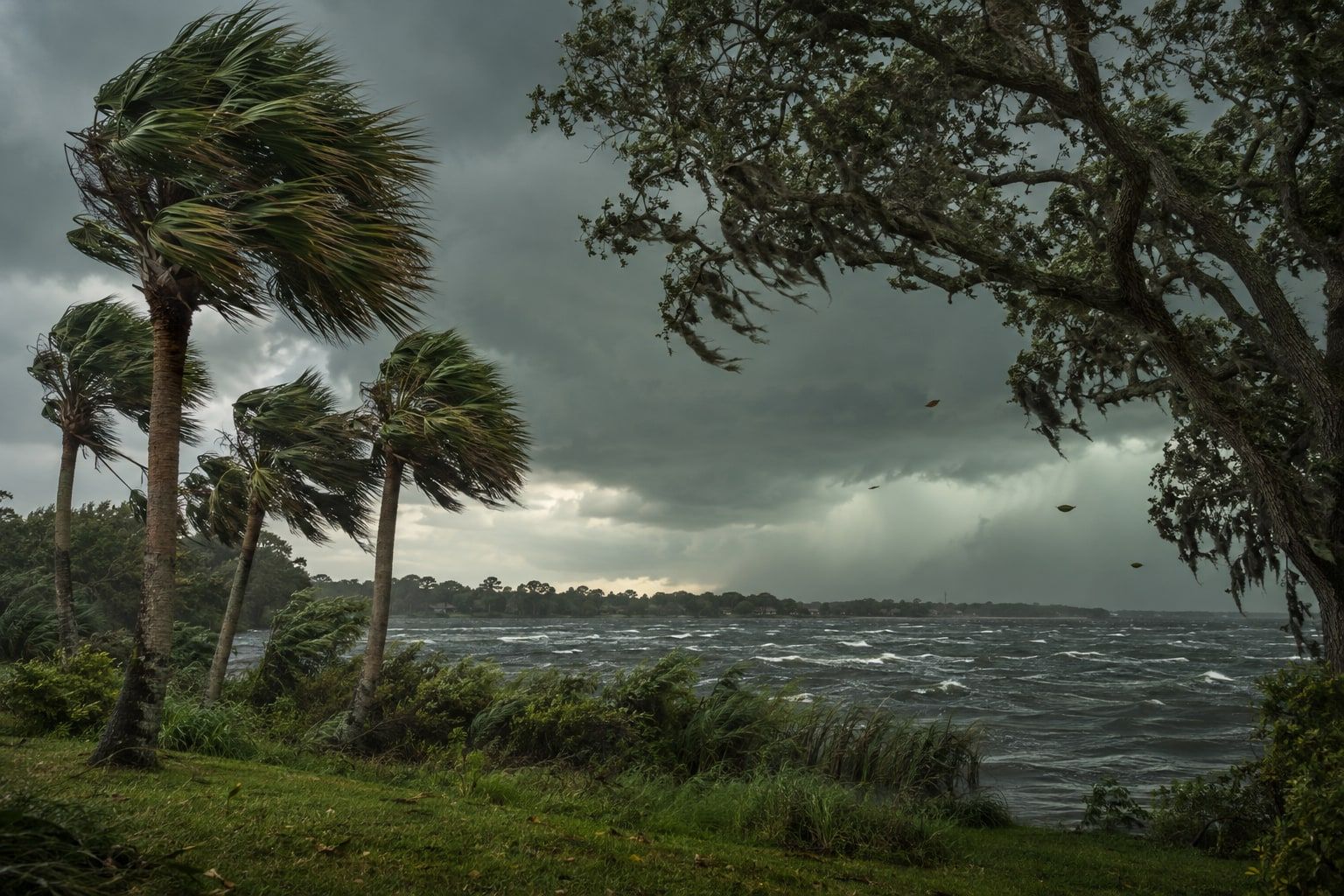
NOAA's daily summaries for the Orlando Sanford Airport record a peak five-second gust of 84.1 mph on October 10, 2024, the morning after Milton made landfall on the Gulf coast. The gust in Hurricane Irma reached 74.0 mph on September 11, 2017, and in Ian 69.1 mph on September 29, 2022. After a storm like these the parts at roof level are the first to look at: a lid knocked loose, a bent screen, flashing lifted along its upslope edge.
Source: NOAA NCEI daily summaries for station USW00012854 (fastest 5-second wind, WSF5); NWS Melbourne, Hurricane Milton impacts
03 / 03
#1. Florida's rank among states for lightning claims on homeowners policies in 2025
The National Weather Service office in Melbourne calls central Florida the Lightning Capital of the United States, and the Insurance Information Institute counted 5,167 lightning claims on homeowners policies in Florida in 2025, more than in any other state. A strike near the house is a reason to look the chimney over afterward, cap and screen included. The Florida Building Code asks for a spark arrestor whose net free area is at least four times that of the flue outlet (section R1003.9.2).
Source: NWS Melbourne, Lightning Information Center; Insurance Information Institute, lightning claims by state, 2025; Florida Building Code, Residential, R1003.9.2
Sanford, from Fort Mellon Park to the airport.
We are based in Sanford, the seat of Seminole County, on the south shore of Lake Monroe. The census counted 61,051 people here in 2020, and the Census Bureau estimated 66,919 for July 2024. The map below draws today's city limits, which take in a stretch of the lake, with eight named places inside them: and along the downtown waterfront, the and to the west, and in the south-west, and the and to the east.
Not sure your address falls inside the line? Call (321) 551-1462 and we will tell you.
Terrain: AWS Terrain Tiles. Water and city boundary: Census Bureau TIGERweb. Place names and positions: OpenStreetMap contributors.
- Sanford
- Fort Mellon Park
- Sanford City Hall
- Goldsboro Museum
- Sanford Community Park
- Hidden Lake Park
- Seminole State College
- Orlando Sanford International Airport
- Midway
What Sanford homeowners ask.
Brief answers; every figure carries its source.
How often should the flue be swept?
Let how you burn set the schedule, not the calendar. NFPA 211 advises a yearly inspection, and a thick coat found during it is what triggers a sweep. Fires are the exception in Sanford: the airport station averages 2.3 nights a year at 32°F or below, and in Census Bureau estimates for 2020 to 2024, 23,677 of the city's 24,875 occupied homes are heated mainly by electricity.
Source: NOAA normals of 1991 to 2020 for station USW00012854; ACS five-year estimates 2020 to 2024, table B25040 (Census Bureau); NFPA 211
Should I book a chimney check before buying or selling?
Yes. For a sale or transfer, NFPA 211 calls for a Level 2 inspection, which goes beyond reach: attic, crawl space and a camera run through the flue. Sanford's stock is mixed. The Census Bureau counts 3,681 homes built before 1960 and 6,654 built between 2000 and 2009, and in three of the city's four local historic districts even repairing an exterior chimney requires a Certificate of Appropriateness first.
Source: ACS five-year estimates 2020 to 2024, table B25034 (Census Bureau); City of Sanford, historic preservation; NFPA 211
What should I look at after a hurricane?
Start with whatever sits highest: cap, crown and flashing take wind and rain before the rest of the stack. At the Orlando Sanford Airport the peak gust reached 84.1 mph on October 10, 2024, in Hurricane Milton, and 16.10 inches of rain fell there in Ian in 2022. No source tallies chimney damage in Florida storms, so go by what you can see from the ground, or ask us to come.
Source: NOAA NCEI daily summaries for station USW00012854
Can a bird or bat in the flue be dealt with any time of year?
No. Chimney swifts fall under the Migratory Bird Treaty Act, and destroying a nest that holds eggs or young takes federal authorization, so work on an occupied flue waits. The Fish and Wildlife Service puts the clear window at September or October through March or April. In Florida, bats may not be excluded during maternity season, mid-April through mid-August.
Source: U.S. Fish and Wildlife Service, chimney swifts and migratory bird nest memorandum MBPM-2; Florida Fish and Wildlife Conservation Commission, bat maternity season
Is a cap really required?
For a masonry chimney, practically yes. The Florida Building Code asks for a cap sloped to shed water, with a drip edge and a caulked break around the liner (R1003.9.1), plus a spark arrestor and a rain cap whose free area is at least four times the flue outlet (R1003.9.2 and R1003.9.3). The City of Sanford can say what it enforces, and the Fish and Wildlife Service asks owners not to cap a flue that swifts use.
Source: Florida Building Code, Residential, 8th edition (2023), sections R1003.9.1 to R1003.9.3; U.S. Fish and Wildlife Service, chimney swifts
My fireplace is a metal unit, not brick. Does it need care?
It does. Factory-built units have their own rules: the Florida code asks for the fireplace to be tested to UL 127 (R1004.1) and for the chimney to be listed and labeled (R1005.1), and CSIA advises a yearly inspection of every chimney, gas-fired ones included, since debris or a nest can plug a flue. Fireplaces are also rarer in new houses: across the South the share of new single-family homes finished with one slid from about 64 percent in 1995 to about 23 percent in 2025.
Source: Census Bureau, Survey of Construction, fireplaces in new single-family houses; Florida Building Code, Residential, R1004.1 and R1005.1; CSIA
Do you work in my part of town?
The office is based in Sanford. For an address you are unsure about, say one out toward the airport or along the lake, ring (321) 551-1462 and we will say.
How do I set up a visit?
Ring (321) 551-1462 or fill in the form below, which accepts requests at all hours. A person phones back to agree a time.
Tell us what you have seen.
Put a few lines on the form or pick up the phone. A person rings you back and the two of you choose a day.
- 1You get in touch A phone call, or a short message on the form.
- 2A person rings back The two of you talk it through and settle on a day.
- 3Roof to hearth The visit follows the stack down, part by part.
- 4You decide We tell you what we found, and what happens next is your call.
Request form
Always open, day or night